
Welcome to the Greiner Lab!
We use ultracold quantum gases on optical lattices to simulate models from condensed matter physics. Thanks to the microscopy technique developed here, we can see and manipulate individual atoms to perform experiments with remarkable levels of control and accuracy.
For the nonexperts, the 10-minute documentary introducing the background, motivation, and apparatus of our lab is a great starting point. To learn about the sciences, follow the links in the navigation bar to each individual lab.
Recent Publications
(View All)
Ultrafast and high resolution spatial light modulation for cold atoms
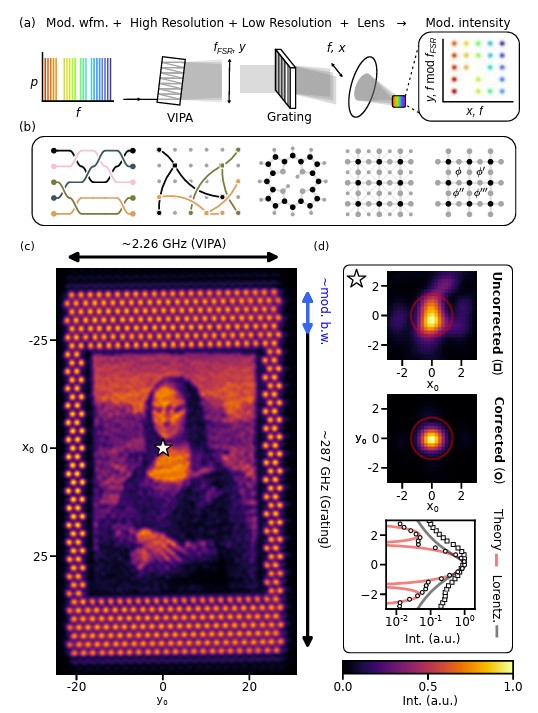
Programmable arrays of ultracold atoms are a leading platform for quantum computation and simulation, enabling state-of-the-art implementations of quantum error correction, and analog simulations of Hubbard models that address open problems in condensed matter physics. In these systems, all local control is mediated through precisely shaped optical fields, and so the challenge of managing many-body quantum states becomes an exercise in optical design. In particular, one wishes for fast, flexible control with low disorder and heating, and access to large arrays with many atoms. An ideal optical system therefore must generate arbitrary patterns with high spatial resolution and low disorder, and alter these patterns on a timescale that is faster than the relevant atomic dynamics. Here, we present an optical system that is comparable to previous approaches in scale, while advancing all other axes. We demonstrate arbitrary pattern generation with \(10^{−3}\) intensity resolution, a frame rate of \(>84\) MFPS (megaframes per second), and a spatial resolution of \(83×52\) beam waists (with \(11×52\) waists accessible via a single 40 GHz electro-optic modulator). These capabilities unlock a new class of experiments. We develop and numerically validate a scheme for fully programmable Hubbard models, with time-dependent control over local chemical potentials, tunneling amplitudes, on-site interactions, and patterns of artificial magnetic flux. The same architecture performs fast, arbitrary permutations of tweezers in 2D, decoupling optical constraints from the design of high-rate error-correcting codes.